
NS4168 vs MAX98357A: Which I2S Class-D Audio Amplifier Should You Choose?
If you are adding a small speaker to an ESP32, Raspberry Pi, STM32, Linux SBC, Wi-Fi speaker, voice assistant or other embedded system, two interesting digital audio amplifier ICs are the NS4168 and the well-known MAX98357A.
At first glance they look remarkably similar. Both accept digital I2S audio, contain the DAC internally, use a highly efficient Class-D output stage, and can drive a small speaker directly.
However, there are some important differences that can make one a better choice than the other depending on whether you are building a prototype, a battery-powered product or a cost-optimised production PCB.
In this article we compare the NS4168 vs MAX98357A from a practical design perspective.
Why Use an I2S Amplifier in the First Place?
A traditional microcontroller audio design may look something like:
MCU → DAC → Analog Amplifier → Speaker
An I2S digital amplifier simplifies this to:
MCU → I2S → Digital Audio Amplifier → Speaker
Both the NS4168 and MAX98357A integrate the required digital-to-analog conversion and Class-D amplification.
This has several advantages:
Fewer external components
Smaller PCB area
Reduced susceptibility to analog noise
High efficiency
Direct connection to an ESP32 or other I2S-capable processor
No separate analog audio DAC required
This makes these devices particularly useful in compact embedded products.
NS4168 Overview
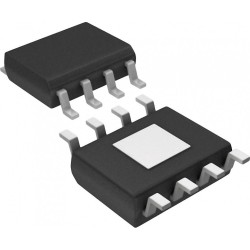
The NS4168 from Nsiway is a 2.5W mono Class-D amplifier designed specifically for digital I2S audio applications.
Buy NS4168 2.5W I2S Class-D Amplifier IC from Hubtronics →
The device integrates:
I2S digital audio interface
DAC
Class-D modulator
Speaker driver
Output anti-distortion functionality
Overcurrent protection
Thermal protection
Undervoltage protection
It operates from approximately 3.0V to 5.5V and can deliver around 2.5W into a 4Ω speaker at 5V. It supports sampling frequencies from 8kHz to 96kHz.
One particularly interesting feature of the NS4168 is its NCN anti-distortion function.
The function is intended to reduce severe output clipping when the input level becomes excessive or when the supply voltage drops. This can be particularly useful in battery-powered products where supply voltage can vary considerably during operation.
MAX98357A Overview
The MAX98357A, originally from Maxim Integrated and now part of Analog Devices, is probably one of the best-known I2S Class-D amplifier ICs in embedded electronics.
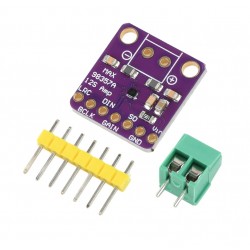
Hubtronics offers both the IC and an easy-to-use development module.
Buy MAX98357A I2S 3W Amplifier Module from Hubtronics →
For custom PCB designs:
Buy MAX98357AEWL+T Amplifier IC from Hubtronics →
The MAX98357A operates from 2.5V to 5.5V and can deliver up to approximately 3.2W into a 4Ω speaker from a 5V supply.
It supports sample rates between 8kHz and 96kHz, does not require an external MCLK, and can select the left channel, right channel or a combined mono signal from a stereo I2S stream.
It is widely used with:
ESP32
Raspberry Pi
Embedded Linux systems
IoT devices
Smart speakers
Voice assistants
Portable electronic products
NS4168 vs MAX98357A Comparison
| Feature | NS4168 | MAX98357A |
|---|---|---|
| Amplifier type | Class-D | Class-D |
| Audio input | I2S | I2S |
| Channels | Mono | Mono |
| Integrated DAC | Yes | Yes |
| Supply voltage | 3.0–5.5V | 2.5–5.5V |
| Maximum output | Approx. 2.5W @ 4Ω, 5V | Approx. 3.2W @ 4Ω, 5V |
| Sample rate | 8–96kHz | 8–96kHz |
| External MCLK | Not required for normal I2S interface | Not required |
| Channel selection | Left / Right | Left / Right / L+R mix |
| Anti-clipping / anti-distortion | NCN anti-distortion function | Output limiting / protection architecture |
| Filterless speaker output | Yes | Yes |
| Quiescent current | Approx. 13mA | Approx. 2.4mA |
| Package | ESOP-8 | WLP / TQFN depending on variant |
| Ease of hand soldering | Relatively easy | Difficult with WLP |
| Module availability | Less common | Very common |
| Documentation / ecosystem | Moderate | Excellent |
| Best suited for | Cost-optimised embedded designs | Prototyping and premium embedded designs |
Published specifications show approximately 13mA quiescent current for the NS4168 versus around 2.4mA for the MAX98357A, making the MAX98357A particularly interesting where idle power consumption is important.
The Most Important Difference: Output Power
At 5V into a 4Ω speaker:
NS4168: approximately 2.5W
MAX98357A: approximately 3.2W
The difference may appear significant numerically, but remember that perceived loudness does not increase linearly with amplifier power.
In many small speaker applications such as:
Voice prompts
Alarm sounds
Notification tones
IoT devices
Desktop gadgets
Embedded HMIs
the NS4168's 2.5W output is already sufficient.
For applications where maximum speaker volume is important, however, the MAX98357A provides some additional headroom.
NS4168's Interesting Advantage: Anti-Distortion NCN
The NS4168 has a feature specifically designed to prevent severe distortion when:
The audio input becomes too high
The power supply voltage drops
The amplifier approaches its maximum available output
This is particularly useful in battery-powered products.
Imagine a portable Wi-Fi speaker operating from a lithium battery.
At full charge the power supply may comfortably support the required audio output. As the battery voltage falls, however, the amplifier has progressively less voltage available to drive the speaker.
A conventional amplifier may simply begin clipping heavily.
The NS4168's anti-distortion system is designed to reduce this behaviour and can also help protect the speaker during high-power operation.
This makes the NS4168 interesting for products such as:
ESP32 voice terminals, portable announcement devices, toys, battery-powered speakers and compact IoT devices.
MAX98357A's Big Advantage: Ecosystem and Flexibility
The MAX98357A has been used for years in maker and commercial embedded products.
As a result, it is extremely easy to find:
ESP32 examples
Raspberry Pi configuration guides
Arduino libraries
Linux device-tree examples
Evaluation boards
Breakout modules
Reference circuits
The MAX98357A also automatically supports numerous PCM/TDM clocking configurations and does not require an external MCLK.
Analog Devices specifies support for 16, 24 and 32-bit I2S data and sample rates from 8kHz through 96kHz.
For engineers developing a product quickly, that mature ecosystem can save considerable development time.
Prototype vs Production Design
This is where the decision becomes particularly interesting.
For Prototyping
The MAX98357A is usually the easier choice.
A ready-made module can simply be connected to an ESP32:
ESP32              MAX98357A
--------------------------------
5V       --------> VIN
GND      --------> GND
BCLK     --------> BCLK
LRCLK    --------> LRC
DATA     --------> DIN
Connect the speaker to the amplifier's differential speaker outputs and audio can be generated directly from the ESP32 I2S peripheral.
The MAX98357A Amplifier Module available from Hubtronics is therefore convenient for experimentation and prototyping.
For Custom PCB Production
The situation can reverse.
The NS4168 comes in an ESOP-8 package, which can be attractive for conventional PCB assembly.
Its larger package is considerably easier to:
inspect
solder
rework
prototype
manufacture using less demanding PCB assembly processes
The smallest MAX98357A variants use a tiny wafer-level package, which can achieve an extremely compact design but requires more capable PCB assembly.
Therefore, for a product being manufactured in volume where absolute PCB size is not critical, the NS4168 can be a very practical alternative.
Power Consumption
One significant technical advantage of the MAX98357A is its low quiescent current.
Analog Devices specifies approximately:
MAX98357A: 2.4mA
Published NS4168 specifications indicate approximately:
NS4168: 13mA
This can matter considerably in products that remain powered continuously but only occasionally play audio.
For example:
Smart Doorbell
The audio amplifier may remain powered for hours while only occasionally playing a notification.
The MAX98357A's lower idle consumption may be preferable.
USB-Powered HMI
If the product always has a 5V USB supply available, the additional idle consumption of the NS4168 may be relatively unimportant.
What About ESP32?
Both devices are particularly well suited to ESP32 projects.
ESP32 devices have hardware I2S peripherals capable of sending digital audio directly to an amplifier.
A typical architecture is:
                 I2S
ESP32  ------------------------>  Amplifier
                                   |
                                   |
                               Class-D
                                   |
                                   |
                                Speaker
There is no need to generate a high-quality analog audio signal inside the ESP32.
This is particularly useful for:
Internet radios
Voice assistants
Talking clocks
Industrial voice annunciators
Smart appliances
Intercom systems
Notification devices
For quick development, a MAX98357A module remains one of the easiest options.
For a production PCB where component cost and assembly simplicity become increasingly important, the NS4168 IC deserves serious consideration.
What About Raspberry Pi?
The MAX98357A is particularly popular with Raspberry Pi because the Pi can output I2S audio through its GPIO interface.
The architecture becomes:
Raspberry Pi
     |
     | I2S
     ↓
MAX98357A
     |
     ↓
  Speaker
Since the conversion and amplification are both performed by the amplifier, there is no need for a separate USB sound card or conventional analog DAC for basic speaker applications.
The MAX98357A's established Linux ecosystem makes it our preferred choice for most Raspberry Pi projects.
Stereo Applications
An important point:
Both NS4168 and MAX98357A are fundamentally mono amplifier solutions.
If your application requires true stereo audio, you generally need two amplifier channels.
For example:
               I2S
                 |
           +-----+-----+
           |           |
       Left Amp     Right Amp
           |           |
        Speaker L   Speaker R
The NS4168 allows left/right selection through its CTRL configuration, while the MAX98357A can also select left, right or a mono combination of the incoming stereo stream.
Where Would We Use the NS4168?
The NS4168 is particularly attractive for commercial products such as:
Industrial HMI
A display needs to generate button sounds, alarms and voice notifications.
The amplifier does not need audiophile performance or extremely high speaker power.
A 2.5W NS4168 is more than adequate.
ESP32 Wi-Fi Speaker
The ESP32 receives an audio stream over Wi-Fi and sends it through I2S directly to the NS4168.
Smart Appliance
Microwave ovens, washing machines, access-control systems and similar equipment increasingly use voice prompts instead of simple buzzers.
Battery-Powered Announcement Device
The NS4168 anti-distortion functionality can be useful where battery voltage varies during operation.
Toys
Low component count, I2S audio and direct speaker drive make this architecture well suited to voice-enabled toys.
Where Would We Use the MAX98357A?
The MAX98357A is particularly attractive for:
Raspberry Pi Projects
Its excellent Linux and Raspberry Pi ecosystem makes integration relatively straightforward.
ESP32 Prototypes
The widespread availability of breakout boards dramatically reduces development effort.
Low-Power IoT Devices
Its low quiescent current is beneficial for systems where the amplifier remains powered but audio plays infrequently.
Compact Consumer Electronics
The tiny WLP package allows extremely small PCB layouts.
Higher Quality Embedded Audio
MAX98357A has extensive published performance specifications, including low distortion, high efficiency and comprehensive digital audio format support.
NS4168 vs MAX98357A: Which One Should You Buy?
There is no universal winner.
Choose NS4168 if:
You are designing a cost-sensitive production PCB
2.5W output is sufficient
You prefer an ESOP-8 package
Easy PCB assembly and rework are important
Your product uses a 5V or similar supply
Anti-distortion behaviour is useful
You are designing an ESP32-based embedded product
Choose MAX98357A if:
You are prototyping
You are using Raspberry Pi
You want extensive software examples
Lower standby/current consumption is important
You need slightly higher output power
You require a very small PCB footprint
You want the support ecosystem of an established Analog Devices/Maxim component
For prototyping:
View MAX98357A I2S Amplifier Module on Hubtronics →
For production PCB designs:
View MAX98357AEWL+T IC on Hubtronics →
Final Verdict
The MAX98357A remains an excellent all-round I2S amplifier. Its low power consumption, 3.2W output capability, extensive documentation and massive ecosystem make it particularly easy to use.
However, the NS4168 is an interesting alternative that deserves more attention from embedded product designers.
For many products, the difference between 2.5W and 3.2W is not particularly important. In those applications, the NS4168's ESOP-8 package, simple I2S interface, integrated protection and anti-distortion functionality can make it an attractive choice for production designs.
A simple way to think about the two devices is:
MAX98357A — excellent for prototypes, low-power applications and designs where ecosystem and documentation matter most.
NS4168 — excellent for cost-conscious production designs where easy assembly, adequate speaker power and anti-distortion performance are important.
Both allow an ESP32, Raspberry Pi or other digital processor to go directly from I2S digital audio to a speaker with remarkably few external components.
Related Products at Hubtronics
NS4168 2.5W I2S Digital Input Mono Class-D Amplifier IC
View Product →
MAX98357A I2S 3W Class-D Mono Amplifier Module
View Product →
MAX98357AEWL+T Class-D Amplifier IC
View Product →
Related Products
Leave a Comment